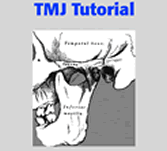
The course of treatment for TMJ depends on whether the symptoms are primarly related to the muscles or disk. For muscle symptoms therapies are used to relax the muscles. Disk involvement requires disk stabilization and jaw stabilization. However, in general therapy involves some or all of the following three phases:
- Relieve muscle spasm and pain:
This may include medications, TENS muscle deprogramming, and muscle relaxation splints.- Stabilize the bite:
Often an orthotic or splint is worn over the teeth. The orthotic allows Dr. Smith to make easy adjustments to the plastic without adjusting the teeth until the bite is stabilized.- Long-term management:
There are a variety of ways to correct your bite in a more permanent way. The most common are:- Equilibration:
Smoothing and reshaping the enamel of the teeth to correct your bite is a simple procedure that does not require anesthesia. It can be used when the bite is only slightly misaligned.- Removable Overlay Partials are permanent orthotics that usually fit over the back teeth and are designed to maintain an aligned bite.
- Reconstruction:
Reshaping the teeth using crowns or bridges permanently realigns the bite and provides structural support for the jaw.- Orthodontics (Braces)
Teeth can be moved into the correct position to stabilize the bite.
Diagnosis is an important step before treatment. Part of your clinical examination includes checking the joints and muscles for tenderness, clicking, popping or difficulty moving. Your complete medical history may be reviewed, so it is important to keep your dental office record up-to-date. Your dentist may take x-rays and may make a "cast" of your teeth to see how your bite fits together. Your dentist may also request specialized x-rays for the TM joints.
Many people suffer to a greater or lesser degree from TMJ. Although women report more pain from TMJ, TMJ in men causes as much or more damage to the teeth, gums, bones and joints. Children are especially sensitive to TMJ and usually show early signs with ear infections, leaning their head on an arm, lip, cheek, or finger biting, sucking or chewing, headaches, snoring, grinding of their teeth at night, and significant chewing of gum.
 |
|
|
|
|
|
|
|
|
|
 |
|
||||||||
 |
 |
 |
|
||||||
 |
 |
 |
|
||||||
 |
 |
 |
|
||||||
 |
 |
 |
|
||||||
 |
|
||||||||
 |
|
||||||||
 |
|
||||||||
 |
|
||||||||

In most cases, TMJ disorders stem from a condition called malocclusion, which means having a “bad bite” or accidents and trauma. However, some TMJ problems result from arthritis or other diseases.
Malocclusion means that your upper and lower teeth do not close together in the correct way—they are misaligned. This includes underbites and overbites. When the teeth are misaligned, they cannot provide the support the muscles in the face need for chewing and swallowing. These muscles are then forced into a strained position, resulting in pain throughout the face, head, arms, shoulders, and back. Although a person may have beautiful teeth or had orthodontics to line the teeth up for aesthetic reasons, the muscles and joints may not be comfortable.
Trauma or injury can effect either the muscles or the joint. Several muscles help open and close the mouth. They control the lower jaw (mandible) as it moves forward, backward, and side-to-side. Both TM joints are involved in these movements. Each TM joint has a disc between the ball and socket. The disc cushions the load while enabling the jaw to open widely and perform rotating and translocational movements. Any problem that prevents this complex system of muscles, ligaments, discs and bones from working together properly may result in a painful TMJ disorder.